Ohio begins redistricting battle during national congressional arms race
In the middle of a national battle to achieve congressional control, the state of Ohio is taking the stage as it undertakes an initiative to redraw the state map.
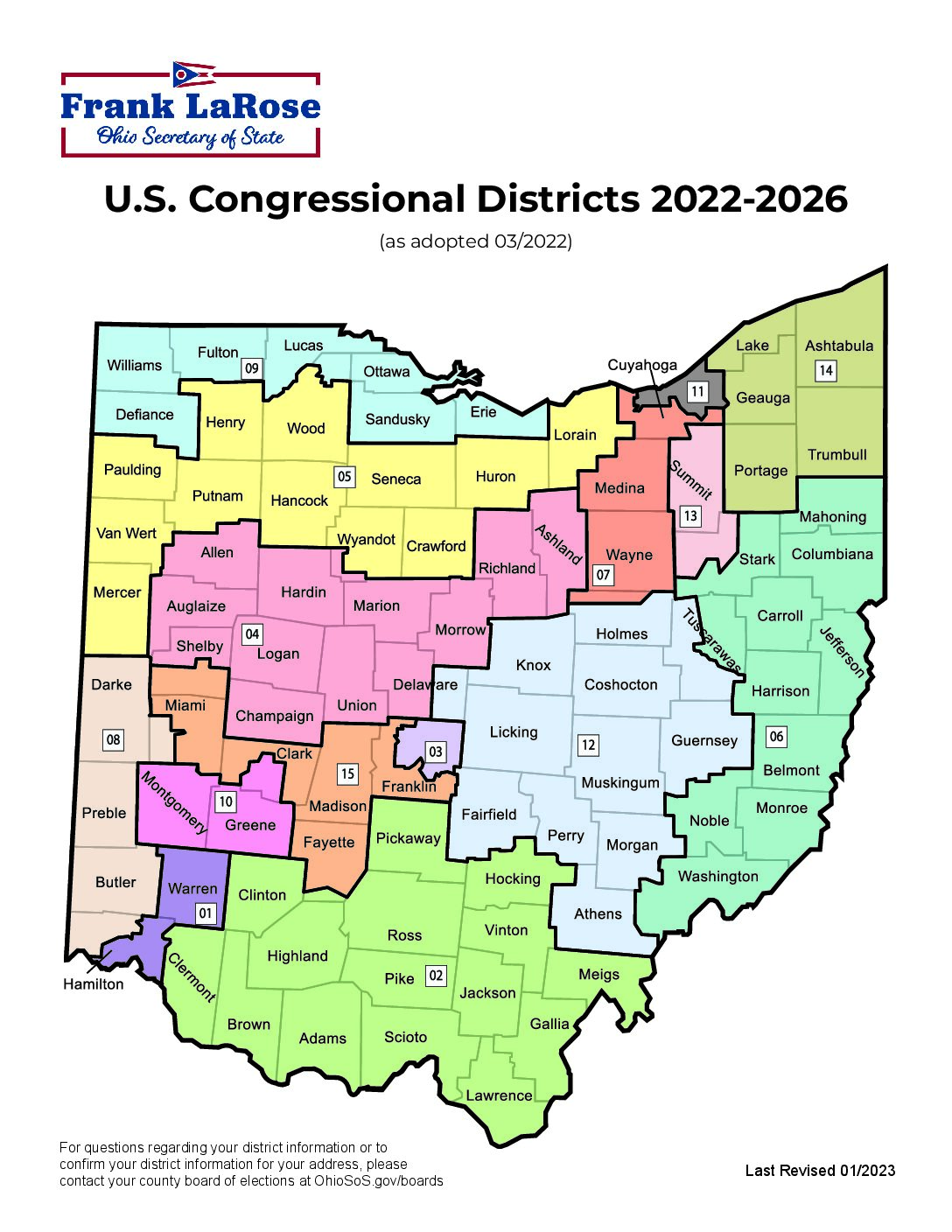
Ohio’s 2022 congressional district map was voted unconstitutional by the Ohio Supreme Court due to Republican gerrymandering and a complete lack of Democrat support. By Ohio law, the map could only be used temporarily until 2026.

This is due to redistricting reforms passed in 2018 and in effect since 2021 to make the process more fair. The reforms made it so that redistricting had proportional voter representation, didn’t favor a particular political party and featured compact districts. For any maps that didn’t meet these requirements, the map’s terms were shortened to four years rather than the typical 10.
Despite these reforms, experts have said the newest map could potentially be even further gerrymandered.
“I think they’re going to shoot for a 13-2 Republican majority in the Ohio delegation, which is an abomination,” David Cohen, political science professor and Director of Applied Politics at the University of Akron said. “Ohio is a Republican-leaning state, but we aren’t Alabama, Mississippi or Oklahoma.”
Ohio’s current map shows a 10-5 (66%) Republican majority in congress, although Cohen believes the map should be closer to a 9-6 (60%) majority to accurately reflect voter trends. In the 2024 election, Republican President Donald Trump won the state 55-44% against Democratic candidate Kamala Harris. Republican Senator Bernie Moreno defeated incumbent Democrat Senator Sherrod Brown 50-46%.
Because the current map did not achieve bipartisan approval, Cohen believes it’s hard to see things changing this time around. He added that Ohio Republicans bypassed the previously mentioned redistricting reforms and have used them to their advantage to redistrict sooner and sooner.
Sept. 30 was the deadline for the Ohio General Assembly to pass a bipartisan, 10-year redistricting map with a ⅗ supermajority vote, as well as the support of half the minority party. Republican leaders were vocal that this deadline wouldn’t be met.
Oct. 31 is the next deadline, as the Ohio Redistricting Commission could pass a bipartisan, 10-year map with a 4/7 majority vote that includes two members from each political party. If this deadline isn’t met, the final deadline is Nov. 30, where a partisan 4-year map could be passed with a majority vote in the Ohio General Assembly.
“Republicans don’t view having four years to redraw the districts as a bad thing, they think of it as an opportunity,” Cohen said. “What Ohio is doing violates the Ohio Constitution. Our maps violate the Ohio Constitution.”
In the past, the Ohio Supreme Court forced gerrymandered maps to be redrawn. Now, there is a 6-1 Republican majority in the court which supports the Republican-drawn maps, no matter how partisan they may seem.
Additionally, Republicans hold super majorities of more than ⅗ (60%) in both chambers of congress and control the governorship. This means that Republicans are in complete control of the redistricting process, giving little chance for Democrats to leave an impact.
“I think it’s inevitable,” Cohen said. “The Ohio Supreme Court will simply rubber stamp what the super majority wants.”
Stark County GOP Chairman Janet Weir Creighton shares a different perspective than Cohen. She said Republicans have won nearly all of the statewide elections over the past decade, which shows that “The Democratic Party is out of touch with the average Ohio voter.”
She added that some districts are drawn fairly while others appear gerrymandered.
“I think the process is as fair as it gets,” Creighton said. “If Democrats want to draw maps that reflect their philosophy, they need to re-evaluate their connection with the average voter.”
Ohio’s redistricting process is underway during a time of national discourse over the topic, as red and blue states across the country are either discussing, planning or going ahead with redistricting efforts. This all stems from President Trump asking Texas legislators to redistrict in an attempt to gain more Republicans seats to extend a slim majority in the House of Representatives.
California legislators fired back with redistricting efforts of their own to neutralize any Republican seat gains which prompted other states to retaliate as well. State officials in Missouri, New York, Illinois and Indiana have all pledged to look into redistricting efforts to add and subtract red and blue seats.

“Donald Trump is the first and only president that has openly talked about redistricting and gerrymandering in a way in which he was encouraging his own party to actually do this so they could win seats,” Cohen said. “This is very much breaking precedent.”
While Governor Mike DeWine and Lt. Governor Jim Tressel said the goal of redistricting isn’t to solely add Republican seats, the same can’t be said for Senator Moreno, a Trump ally who called for additional red seats in the redrawing efforts. Although DeWine and Tressel have significant influence in the process, Cohen believes Trump’s voice will be the loudest.
“The state legislature doesn’t resemble a Mike DeWine type Republican party,” he said. “The state legislature is controlled by a super majority of Trump-aligned MAGA Republicans. They will take their marching orders from the White House.”
Several organizations and coalitions have formed in Ohio to battle and end gerrymandering. One of those groups is Fair Districts Ohio, a nonpartisan coalition of several organizations such as Common Cause Ohio, The League of Women Voters Ohio and the ACLU of Ohio.
The coalition holds events, collects signatures for ballot initiatives, holds mapping competitions, testifies at hearings, stages protests and rallies and holds educational programming to battle gerrymandering, according to Mia Lewis, Associate Director of Common Cause Ohio. Lewis said that at its core, gerrymandering puts democracy at risk.
“Fair maps are one of the foundational blocks of democracy, so if we don’t have fair maps, we can’t have a functional democracy,” she said. “When maps are rigged, democracy is rigged. It’s harder for people to care and get involved, and it’s harder for people’s voices to be heard.”
Due to the unfairly drawn districts, Lewis said elected officials can overly focus on the primary and instead of the general election. This can lead to an extreme ideology and elected officials not listening to the opposing voter base.

“When you have extreme politicians in power, they can’t negotiate and they can’t work out solutions that work for the benefit of all Ohioans,” Lewis said. “You end up with a really dysfunctional government.”
Gerrymandering can crack certain communities and split them apart into different districts for political gain, according to Lewis. This can potentially cause members of these communities to be in the minority party and never receive a good chance to elect a candidate they identify with.
“It’s very often that gerrymandering happens on the backs of minority voters and other underrepresented communities,” Lewis said.
The three Democrat seats Republicans might target in the redistricting process are Emilia Sykes of District 13, Marcy Kaptur of District 9 and Greg Landsman of District 1. All three seats were competitive in last year’s general election, and could become split up to give Republicans a huge advantage.
District 13 is made up of Summit and Stark counties, and it includes the city of Akron. Previously, Akron was a part of two different districts, which according to Cohen, made it very difficult for the Akron area to receive substantial representation as opposed to when it’s been represented by one legislator. He added that it was typically an afterthought compared to the city of Cleveland.
“It’s somebody that’s advocating for the area and trying to get congressionally directed spending to Summit County, which creates jobs and helps boost our universities and libraries,” Cohen said. “When you have somebody representing an area, it’s usually not left behind or forgotten about.”
Bryan Williams, the chairman of the Summit County Republican Party, sees it differently. He hopes District 13 is redrawn to include only the city of Akron or the city of Canton.
Williams said most urban centers in Ohio are placed within one district, such as Cleveland, Columbus, Cincinnati and Toledo, and that District 13 is the only district with two large cities.
“It’s a fair and very doable ask,” he said. “It’s a somewhat minor modification to the lines.”
Sharing a similar opinion to Williams, Creighton hopes Stark County is drawn into its own district.
“Republican’s control the state legislature, so we should have the ability to draw maps that reflect our majority,” she said.

Although Cohen and Lewis view the upcoming redistricting process as dire, they both believe there are potential solutions. Lewis encourages citizens to take a grassroots approach and join an anti-gerrymandering organization and educate themselves and others.
She believes contacting your local legislator about redistricting worries, talking with neighbors and sending letters to local media outlets can make a big difference in the long run.
Cohen hopes for anti-gerrymandering groups to once again come together and collect signatures for a referendum on the ballot to create an independent commission to handle redistricting.
“It would take it out of the hands of politicians and elected officials who draw these lines to benefit themselves and their own political parties,” he said.
Issue 1 was a similar referendum placed on the ballot in 2024 but failed to pass. Cohen contributes its failure to confusing ballot language and the backdrop of the presidential election which overtook it in importance. He believes placing it on the ballot for the 2027 general election after the 2026 midterms would be perfect timing.
“I think it’ll win overwhelmingly,” Cohen said.
While gerrymandering has become the norm during the Ohio redistricting process, both Cohen and Lewis believe this fight is far from over. Although anti-gerrymanders have suffered a string of losses, Lewis is refusing to give up and stand idle.
“I certainly know that Ohioans will continue to fight for fair maps no matter what, because it’s really important to them,” she said. “We believe in democracy, we believe in fairness and we believe that every voter should have an opportunity to have their voice be heard.”
The Ohio Republican Party could not be reached for comment.


You must be logged in to post a comment.